
Draft placeholder — review before publishing. Figures and examples are illustrative and should be verified against current sources before this post goes live.
Every operator I talk to wants to know the same thing before they open a search for an operations leader. Not "how much will it cost to hire?" They want to know: "what happens if we get it wrong?" Fair question. In aviation, the answer is bigger than most people think.
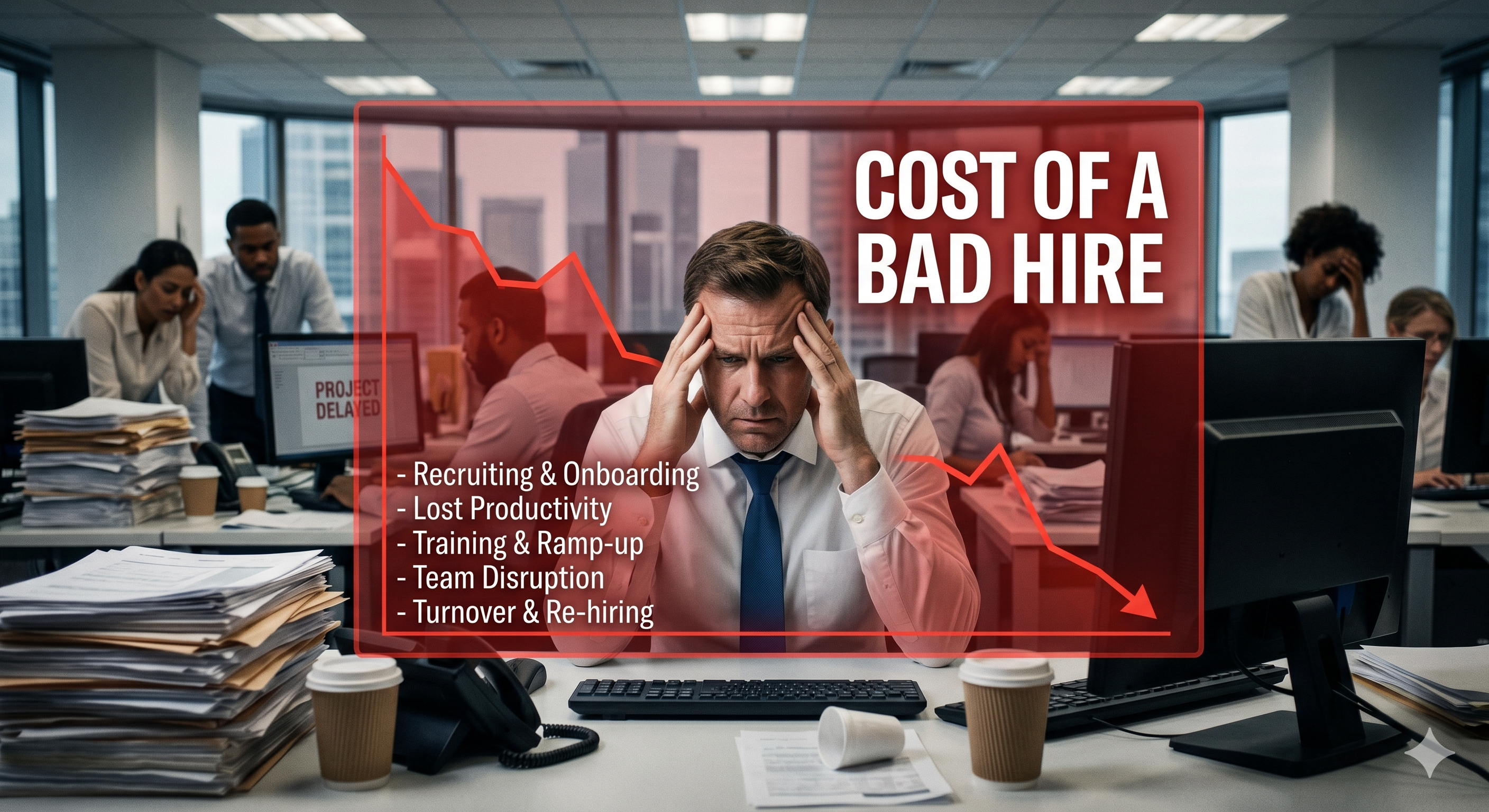
A bad operations leadership hire at a scaling aviation or aerospace business can cost $500,000 or more once you count the full damage. That number shocks people the first time they see it. Then I walk them through the math, and in an industry where a single grounded aircraft can burn tens of thousands of dollars a day, it stops shocking anyone.
Here is the full picture. What a bad hire actually costs, why aviation companies pay more for the mistake, and how to reduce the risk of making one.
What Counts as a Bad Hire
A bad hire is not just someone who gets fired. It includes anyone who leaves inside their first year, anyone who underperforms so badly the team works around them, and anyone who technically stays but holds the operation back from the throughput, quality, and safety performance they were hired to drive.
Research from CareerBuilder puts a hard number on how common this is. Seventy-four percent of employers admit to making a bad hiring decision, and 80 percent of voluntary turnover stems from poor hiring choices. Three out of four of you reading this have made one. Most of you have made more than one.
At the operations leadership level, the failure rate is worse. Industry data suggests 30 to 40 percent of executive hires fail within 18 months. At aviation and aerospace companies promoting into their first VP of Operations or Director of MRO, I see the rate climb higher. Leaders hire the person who impressed them in an interview, not the person who has run a high-rate, safety-critical, AS9100-governed operation at the exact next stage their business is about to enter.
The Direct Costs
Let's start with the costs you can count. These are the invoices and line items that hit your P&L the quarter the hire leaves.
Recruiter fee
If you used a traditional retained firm charging 25 to 30 percent of first-year compensation, a $250,000 VP of Operations hire cost you $62,500 to $75,000. That money is gone. Most firms will rerun the search under their guarantee, but your clock already started.
Salary paid to the wrong person
Average tenure of a failed operations leader is six to nine months. At $250,000 a year, that is $125,000 to $187,000 in salary paid to someone who was not moving your operation forward.
Severance and legal
Three to six months of severance is standard for a director or VP exit handled cleanly. For a $250,000 base, that is $62,000 to $125,000, before legal fees to paper the separation agreement.
Benefits, equipment, and onboarding
Benefits run 20 to 30 percent on top of salary. Relocation if you paid for it, plus the cost of clearances, systems access, and the time senior staff spend bringing a new operations leader up to speed on your processes and quality system. Another $30,000 to $50,000 minimum.
The second search
You are starting over. Another $60,000 to $75,000 retained firm fee, or the cost and time to do it yourself.
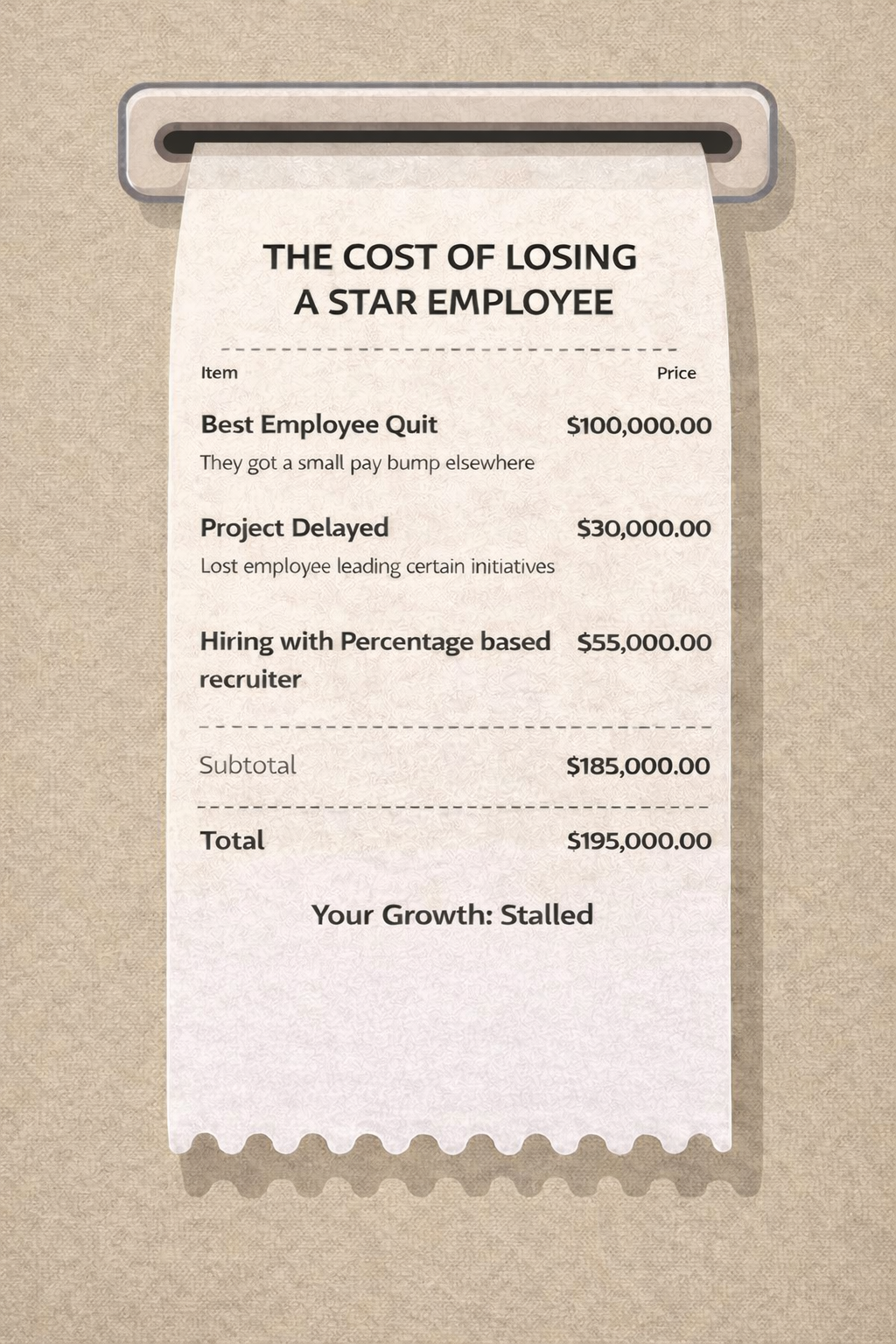
Running total on direct costs for a $250,000 operations leader who doesn't work out: $340,000 to $512,000.
The Hidden Multiplier
The direct costs are the boring part. The hidden costs are where the real damage lives, and in aviation they are harder to see until an aircraft is on the ground or an auditor is in the building.
Opportunity cost
Your VP of Operations was supposed to lift on-time delivery, cut turnaround time, and clear the backlog this year. Instead, throughput slipped and the backlog grew. That's not a salary problem. That's a delivery problem that rolls forward into every customer commitment and every forecast you build.
Team damage
Gallup's 2025 State of the Global Workplace research showed that managers account for 70 percent of the variance in employee engagement. A bad operations leader does not underperform in isolation. Their direct reports disengage. Some leave. In a labor market this tight for licensed mechanics, certified inspectors, and experienced production supervisors, the people you can least afford to lose are usually the first out the door, because they have options.
Safety and compliance damage
This is the one unique to our world. A weak operations or quality leader can let a process drift until it produces an escape, a finding in an FAA or AS9100 audit, or worse. A safety culture takes years to build and one bad leader to erode. Once a regulator or a major customer loses confidence in your quality system, you are operating under scrutiny — and sometimes under restriction — until you earn it back.
Culture damage
Every day a mismatched leader stays in the seat, the team's confidence in the operation drops. The worst version is when leadership clearly knows it's not working but can't bring themselves to make the change. The floor sees that. They remember it, and on a shop floor or a hangar line, that erosion shows up in quality and safety performance.
Customer and AOG damage
This is the one that hits aviation companies hardest. A poor Director of MRO can blow a turnaround time and leave a customer's aircraft on the ground, where AOG costs run into the tens of thousands of dollars per day and the customer remembers exactly who caused it. A weak operations leader can miss a delivery slot to an OEM and lose your position in the next program. In aviation, your operations leaders represent you to customers, regulators, and prime contractors every week. When they are the wrong people, the market notices fast.
Leadership attention drain
The cost nobody puts on a spreadsheet. Every hour you spend managing around a bad hire — sitting in on production meetings you shouldn't have to, fielding customer escalations, walking the floor to keep things moving — is an hour you are not spending on the ten other things a leader has to do. Multiply that over six to nine months.

Why Aviation Companies Pay More for Bad Hires
Every industry has bad-hire stories. But aviation is especially unforgiving, and there are a few reasons for that.
Aviation runs on tight margins and fixed commitments. A weak operations leader isn't just missing a target. They are costing you delivery positions you already negotiated and customer trust that takes years to rebuild.
Regulatory standing is non-negotiable. If your quality leader lets the system drift into a finding, you don't just replace the leader. You rebuild your standing with the FAA, your registrar, and your customers' supplier quality teams from a position of weakness.
Customer relationships in MRO and on the OEM supply base are personal and program-bound. A Director of MRO who mishandles a key account can lose your shop a recurring revenue stream. A VP of Operations who misses a rate commitment can cost you a spot on the next aircraft program.
Capital and lender confidence is fragile. If you are a backed or acquired aerospace business and you miss a board update because your operations team is underperforming, the next conversation about growth capital gets harder. The one after that gets harder still.
None of this shows up on an invoice. All of it costs you.
How to Reduce the Risk
There is no way to make an operations leadership hire risk-free. There are ways to dramatically reduce the risk, and most of them happen before the search ever opens.
Define the 30, 60, and 90 day outcomes before you write the job description
Not responsibilities. Outcomes. What specific thing does this person need to have accomplished by day 90 for you to know they are the right person — a stabilized turnaround time, a cleared audit corrective-action list, a rate increase held without a quality escape? If you can't answer that, the search will fail. Not because the candidate will be bad, but because there is no way to tell a good candidate from a bad one.
Go beyond the resume
Every candidate we present at High Altitude Partners comes with a full written evaluation, not just a one-page resume summary. The evaluation covers career motivations, leadership style, and what the candidate thinks they are best and worst at. You can see the process here. A resume tells you what someone did. It doesn't tell you how they think under a rate ramp or an audit — which is the only thing that actually predicts whether they'll succeed in your operation.
Reference intentionally
Most reference checks confirm what you already believe. Good reference checks do the opposite. Ask the references what the candidate is bad at. Ask what environment they underperform in. Ask how they handled the last quality escape, the last AOG event, the last failed audit on their watch. You are trying to disconfirm, not confirm.
Align the recruiter's incentive with yours
This is the one most leaders miss. When your recruiter earns more if the candidate's salary is higher, they are incentivized to push you toward the most expensive candidate you will say yes to. When your recruiter earns a flat fee regardless of the offer, they are incentivized to find the right fit. It is the same fee either way. Here's how we price every search.
Build in a real guarantee
Every search we run comes with a 90-day hiring guarantee. If the placement leaves or is let go inside 90 days, we rerun the search at no additional cost. This is not marketing. It is how we stay accountable for the work. When your recruiter is willing to put their work on the line, their incentives are finally aligned with yours.
The Bottom Line
A $250,000 VP of Operations hire at an aerospace manufacturer or MRO doing $30M in revenue is one of the most consequential decisions a leader makes in a year. Done right, that hire lifts throughput, holds the rate, and keeps your quality system audit-ready. Done wrong, that hire costs $500,000 in direct damage and an unknown amount in AOG downtime, compliance risk, team disruption, and lost program position.
The difference between those two outcomes is not luck. It is preparation, it is process, and it is working with a recruiter whose incentives actually line up with yours.
Every operator I talk to wants to know the cost of a bad hire. The real question is whether you have the process in place to avoid one.
Hiring an operations leader in aviation or aerospace this year?
We run retained executive searches at a flat fee, with a real-time client portal, written candidate evaluations, and a 90-day hiring guarantee on every search.